In eigener Sache

Photo by Serpstat on Pexels.com

Panta Rhei

It was bound to happen. You can take Mat out of Germany, but you can’t take Germany out of Mat.
Addressing two challenges—one linguistic and one very worldly.

Challenge #1

In eigener Sache. It is what it is, but it is difficult to translate into English. Literally: in one’s own matter. Often used in company announcements that pertain to the company itself. Please note … does not really capture it. We are happy to announce … does not fit the context I am thinking of. Any suggestions that go beyond the the discussions in the forum of the online dictionary leo.org?

Until you come up with something better, I will just call it About us, which is

Challenge #2

Life goes on. Work piles up. COVID-19 has been confusing people, making many sick, and killing far too many. Too many lost their livelihood, feel frustrated and excluded, and wonder when and how this will end. And many say: I can’t breathe. Not now and not before.

And that is just the context. For this blog. On May 2, more than two months ago, I wrote the last post. Silence. Busy processing. Busy with busy. Busy learning, trying to understand. To understand what’s going on.

Doesn’t writing help? To process? To understand? Yes, it does. For me, it does. Reading also helps, doesn’t it?

So, what’s the challenge then? Finding the time to write, before one is overtaken by events. Having the energy to key in thoughts. Being focused on writing about one when a trillion is happening all at once.

But that is not all. Writing when everybody is talking is hard. Is anybody listening? Am I listening? Enough?

The danger of missed connections…

Anyone who has done some amount of air travel will be all too familiar with the destructive power of missed connections. Suddenly, a well-coordinated travel itinerary becomes a cascading, downhill disaster of cancelled reservations, revised schedules, and the best laid plans gone “aft agley.” But these examples are in the extreme, derived from the most compacted, intensive of situations. It should lead us to wonder if there aren’t other kinds of missed connections in our more mundane, everyday lives and interactions. If so, are the less salient, but still very real, consequences moment-to-moment missed connections diminishing the quality of our relationships and, by extension, of our shared existence? This is what I invite you to consider with me today.

In the world of improvisation, or improv as it is more colloquially known, there are a few simple rules that govern all interactions between players. The most well-known amongst these is the famous “yes, and.” In the simplest sense, this means that whatever a fellow improv artist does or says in a scene needs to always be greeted with the spirit and actions of “yes, and,” never “yes, but” or worse yet “no, but.” In order to prepare for performances, improv artists often practice energy exercises in pairs or in larger group circles. These exercises are predicated on each member recognizing, and then responding positively to the energy that their fellow players offer them. You offer unbridled joy? I recognize it and offer my best version of the same. You come with sober gravitas? Right back at you, but not in a serve-and-volley sense. Rather, in a “thank you, and yes, I’ll join you in that” fashion. The point is to connect and join with whatever your partner(s) offer up. Only in this way can true improvisational performance work for both the players and the audience.

What does this mean for us, as leaders, parents, teachers, colleagues, neighbors, and friends? Well, ask yourself this: how often do you meet the energy of those around you with a genuine spirit of “yes, and”? How often do you return eye contact and connection offered to you by a subordinate, a child, a co-worker, or the cashier at the supermarket? More to the point, can you think of times when, likely without the benefit of conscious thought, you averted your gaze before that connection could be made? I know I can, and it is not just because I tend toward introversion (though that is certainly part of the equation). No, I believe that it is because, especially in contemporary society, we are increasingly conditioned to forego these micro-connections and fleeting offers of shared energy. Why? Well, because they threaten to distract us from our preferred distractions, which is to say they stand to draw us back into a world that we increasingly strive to escape at every turn, through the ubiquity of our cloud-connected devices and the non-stop push alerts that dominate our every available neuron.

In his book “On Tyranny,” historian Timothy Snyder encourages us to “make eye contact and small talk” as one of his twenty lessons for the 20th century. So, what I invite us all to do today is really quite simple. I am not suggesting that we should prowl, stalker-like through our day, seeking to establish eye contact with every person who happens to wander within arm’s reach of us (or worse yet, with people minding their own business from across the room!). No, instead I am presenting us with the encouragement to set an intention; to accept those small invitations to connect, which we all too often simply miss, with our fellow humans. In doing so, we may be surprised at what we find, and all that it has to offer us in this ongoing improvisational performance called life…

Panta Rhei — what does that mean?

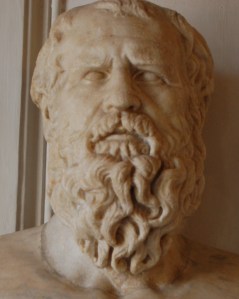
It is Greek, and not just to me. I am told the translation is: Everything Flows. The first one to say this was the Greek philosopher Heraclitus (c. 535 to c. 475 BC). He believed — as do we — that everything always changes, that we can understand ourselves and the world around us better, if we start with the premise of ever-present change. It is that change that we experience as development. Sometimes we are happy with it, sometimes — not so much. Sometimes we like the speed and direction of change, sometimes we don’t.

Bust of an unknown philosopher. This one is in the Hall of Philosophers in the Capitoline Museum in Rome, labeled number 3. One suggestion is that it is Heraclitus, but the museum makes no such assumption.
By RoyFokker - Own work, CC BY-SA 4.0, https://commons.wikimedia.org/w/index.php?curid=10805964
Bust of an unknown philosopher. This one is in the Hall of Philosophers in the Capitoline Museum in Rome, labeled number 3. One suggestion is that it is Heraclitus, but the museum makes no such assumption

Heraclitus was known as the Obscure Philosopher. He apparently enjoyed playing with words, but more importantly, he believed in the unity of opposites and assumed there is some harmony in this world. Today, we capture the unity of opposites — things are plus and minus at the same time — as one part of a dialectic. [More on that in a later blog post.] It is difficult to understand and then express opposites at the same time. Helping somebody is both positive and negative simultaneously and subsequently: it is positive because the helped benefits from the help, it is negative because the help curtails, prevents, or even disables the potential for the helped to act for themselves. We are capable of self-determination — autonomy — and make our own choices; at the same time, we are always also other-determined — heteronymy: we choose to act on our want for a nice meal in a comfortable environment and might go to a restaurant. Quite determined, we hop into the car and drive off downtown. The restaurant owner might have decided to not serve dinner at 2am at night and went to bed already. Our eating habits are also determined by that and by many other decisions and choices many other people made.

So, in large part because of these tensions between opposites, because of different factors bouncing off off each other, changing, amplifying, and cancelling each other, and because of each of us determining to some extent how we are going to act at any given moment, something or other is always happening — everything always changes.

Heraclitus also said: No man ever steps in the same river twice. We use this sentence as the tag line for this site, by only changing one word: No one steps in the same river twice. In our experience and from our perspective, change from the “outside” does affect everybody the same and differently; everybody changes the same and differently—independent of our gender.
Why doesn’t anybody step in the same river twice? The river always flows; one way of looking at it is that it is not the same river water just a second later. And we also change. When we step into the same river (if this were possible), then we are not the same; we are a little older, maybe a little wiser, maybe just a little more hungry, or already wet …

Such constant change is complex in itself, and we often perceive it as such, and, when we are in the midst of it — and we often are — we find it complex and complicated to deal with this change.

We believe it is good to think about the complexity of change, to talk about it, understand it better. We don’t want to simplify change, belittle it, or reject it. Change is all around us and all within us; we might as well understand it better. In some way or another — based on the concepts in our blog post tags — we will always look at change, and not only in our blog writing.