

What’s the problem?

Photo by cottonbro on Pexels.com

On the complexity of change

Hey, Friend,

It’s been a while since I have written about the complexity of change. You say you didn’t even notice? What has been the problem? Yes … for me as well. For me: the usual: too many fingers in too many pies. Some days, I felt like I was kneading dough in 713 bowls in rapid succession. Hour after hour. Day after day. I got it somewhat right in one bowl, while the yeast was bubbling aggressively in all the other bowls … It looked like the more I worked, the more dough there was to knead.  

What was your problem? Why didn’t you do the things consistently that you wanted to do? What has changed? What did not? Were you able to solve this problem? Over time? Instantly? Not to worry, I won’t keep bugging you. Let’s look at the problem differently.

Problem-solving has figured in my previous blog posts, but we have not really taken a step back and looked at what a problem is. Why would one want to know you ask. Well, it is often easier to address something, disentangle something, work on something, once we understand this something better. Also at an abstract level. When we abstract, we take away some features, characteristics of a complex thing or process, to be able to focus better on the ones we did not remove or ignore. Done right, the abstraction is more widely applicable, not just to the thing we abstracted from but also to similar ones. We have learned something that will help us …

Alright, what’s a problem? We want to gain an abstract understanding, therefore we are not asking: what’s the problem? Actually, it’s best to have a couple of problems. I know this might only be true for this thought experiment; but maybe it isn’t, let’s see. We take a bunch of problems and compare them to one another. What do they have in common? What is specific to only one problem? The specific features, we can probably discard. They are unlikely to be part of a problem generally; they are just part of this one. This way, we get the general idea of what a problem is. After this generalization, we can abstract. And again, this is often helpful both for encountering other problems and for dealing with the one you are facing right now; at least we know something before have to dive in deeper into the specific problem of the moment. During this further abstraction, we look at each of the general features of our set of problems, and we are working out which of the factors, components, and traits we found across our problems actually make this a problem. Which of them are essential? These are part of the essence. If it were possible to remove the these characteristics — and in our thought experiment everything is possible — then the problem is not a problem anymore. It would be something else: a gift, a nice note, or a lawnmower. We just don’t know — anything but a problem. So, in generalizing, we only take note of the features that are general to our bunch of problems; and in abstracting we focus only on the general features that are essential, in that they make each problem a problem.

You knew all this, you say. I had an inkling you might say this, and I will oblige: Let’s jump right to the highest – or is it deepest? – level of abstraction. I am sure you understand that I had to say what I wrote until now, so that we are able to dive into this abstraction without suffocating in fuzzy matter. 

Abstracting, each problem has two features. (1) There are two states: one — we call it state C for Challenge — is here right now in all its glory, and state G — we call it G for goal — is longingly desired, deeply wanted, desperately needed, or harshly ordered and may exist some time in the future. (2) There is a gap or an obstacle, like a hurdle, between state C and state G. Now, that’s a problem. How are we going to solve it? Let’s do this analytically.

We look at the different parts and features of the problem and their context. What is state C like? What is its context, both in time — its history or pedigree — and space — what else is there in its environment: what entanglements, dependencies, consequences, but also what leverage and tools. And how do you envisage state G? What’s your goal? Consider that in context, again both in time and space, as well. Everything going well, you will gain a good or at least sufficient understanding of both states.

Of course, the gap or obstacle is a different one in each problem. We will leave that for another post. In a previous post, I have described simple, linear, and complex problems and have given an example of a chaotic problem. Each of these is best suited to a different approach to problem solving. In a later post, I will also allude to the difference between well-defined and ill-defined problems.

Until then, why don’t you have a look ’round, read or re-read some earlier posts. Let us know what you think.


Change the blog

I found this beautiful image, when I put in the keyword chaos.
Photo by Dids on Pexels.com

Hey, Friend,

It’s been a while. Well, it’s complicated. Life is complicated. It is complex. And blogging does not make it any easier.

Have you ever wondered why there are two words – complicated and complex – that seem to be very similar? I have just described life as both complicated and complex. It is clearly complex; multiple actors, components, and factors play a role and interact with one another. In a previous post, I have sketched these as the characteristics of complexity. I am labeling something as complicated, when I perceive the inherent complexity as challenging; and I guess I am not not the only one. So, complexity is independent of the person, the subject, looking at it; it is objective (mainly determined by the object). Complication, on the other hand, is dependent on the perception by the person – do I find something complicated – and is hence subjective (mainly determined by the subject). The two go hand in hand, of course, and influence each other, but that is a topic for another post.

… and blogging does not make it any less complicated, because blogging is complex. How so? If you have observed – the scientific word for having look at or in this case read – my blogging on this site, you have noticed that it has been a nonlinear trajectory.

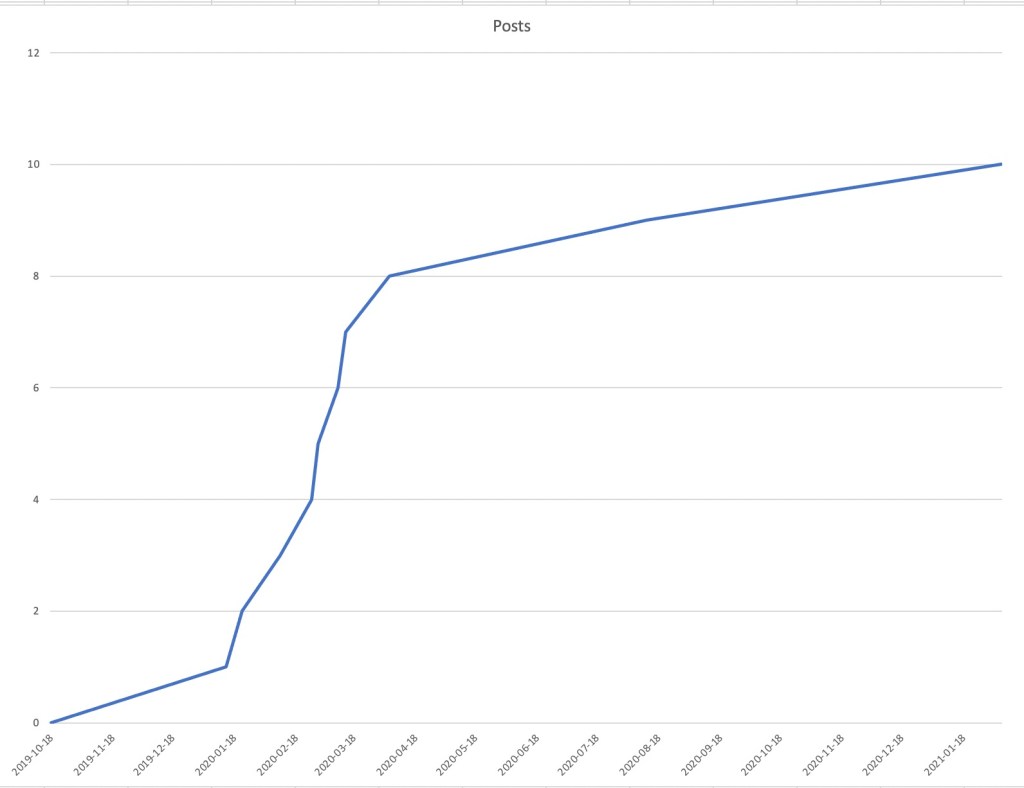
Let’s sketch a timeline. On October 18, 2019, I wrote the very first blog post on this site. The first post in the series On the complexity of change appeared about three months later. Over the last year or so, only 10 posts appeared.

Look how flat the curve became, what’s going on?

And these posts were surely not distributed evenly over the months and weeks of the last 12 months. So, what gives? The timeseries graph depicts a nonlinear developmental trajectory. But I added one post after the other? Sure, but the lagtime between posts varied immensely. The nonlinear order of topics of the nine posts — Intersection of change and complexity > Cynefin: simple and linear problems > Complex problems > Characteristics of complex adaptive systems > Sensitivity to initial conditions > Disproportionate change > Understanding complexity narratively > Example of a chaotic problem > Time in complex adaptive systems — also shows a nonlinear trajectory. Is this something I should be worried about? I sometimes do; and I sometimes don’t.

Let’s look at this series of blog posts through the lens of complex adaptive systems (CAS) by asking three questions: (1) What were the initial conditions? (since we know that CAS are sensitive to initial conditions) (2) What are the growth conditions? (3) Which variables have induced and are inducing change?

What were the initial conditions?

This blog and the Panta Rhei website started off as a good but pretty vague idea. We had a bunch of ideas that we wanted to try out, thought that we had a couple of meaningful things to share, a decent level of computer literacy and of familiarity with online media, but no clear concept of the goal of the whole enterprise and still a lot to learn about blogging, social media, and online presence. In addition to writing blog posts, I worked on the infrastructure of the site, learned a lot from other bloggers, joined a writing group, read up on small online consultancy businesses, took some WordPress tutorials, brushed up on my knowledge about Facebook and Twitter. So, what might not be obvious from the graph above or the ostensible hodgepodge of topics in the series, is that a lot of learning occured. That’s how educator-theoreticians put it, meaning I learned a thing or two on the process, which in one way or another was the main point of the whole endeavor. Up to this point and probably for a little while longer, the main hope I had and still have is that I learn new things and enjoy the journey. Of course, if you find the posts interesting, entertaining, worthwhile, … this is even better.

The initial conditions — a vague idea combined with openess, a lack of experience in blogging combined with a good aptitude and an eagerness to learn, and an unclear focus combined with the strong intent to sharpen it over time — kept recurring in the iterative process of blogging.

What are the growth conditions?

Most complex adaptive systems are open. This means, if you are lucky, there is a constant influx of energy, which influences the complex process. Events external to this blog change the trajectory of the blog. Their energy can induce growth or curtail such growth. The last 12 months have also been the 12 months of COVID-19. Did this divert some of my energy away from the blog? Surely. But it also stimulated my thinking and gave me examples for the discussion of exponential growth, chaotic problems, and nonlinear delopments. Not all growth conditions are external to the CAS. In our case, it have been mainly the “positive” initial conditions, which have turned out to be growth conditions. When I made progress on improving the infrastructure of the site, defined the focus more clearly by moving a couple of posts to my personal blog and transfering some from there to here, the writing got easier and things picked up again. When I learned how to better integrate the blog with its social media, more people became aware of the posts, which in turn increased my motivation.

Which variables have induced and are inducing change?

At first sight, the answer is simple: pretty much anything and everything. Other processes – many of them also complex – impact the process of blogging on the Complexity of change, whether it is the personal life, work, hobbies and exercise. Internally, very little helps and hinders. In one of my future posts, I will take a closer look at how to handle the myriad of variables in any complex adaptive system. And yes, there are a number of ways.

Until then, why don’t you have a look ’round, read or re-read some earlier posts. Let us know what you think.
It’s time — now

Hey, Friend,

Time, doesn’t it fly … I have not been wasting any time. I had no time. There simply never was a time when I could sit down and write. Perhaps, it wasn’t the right time. A time to gather stones? A time to cast them them out?

Time!
Chris, I am always reading your comments immediately. In a timely manner, so to speak. And then I think, I should pick up on this, I should pick up on that. And then time goes by … In both my brief exploration of the word herd immunity and your comment to that post, we talked about our schedules. Yes, schedule, time management, the passing of time, the future, … have been on my mind for some time.

Time: Just now, I have learned that the word schedule is related to the German noun Zettel and the Spanish cédula, simply meaning a sheet of paper, a note sheet. How do I know, you ask. Well, I looked it up at https://www.etymonline.com/word/schedule. I learned that schedule only came to mean a sheet with a timetable in the nineteenth century. Does this mean only with the beginning industrialization schedules became more important? Are they important to you? How important is it to be on time? Is it important to you to do something in time?

Time? What is that anyway—time? Is it ambiguous?
We measure. Each hour has 60 minutes. Exactly. Each day—only 24 hours.
We plan: I will work on this blog post today. We will finish the project next week. School begins next month.
We experience: This took forever. That went by so quickly.
We remember: Has it really been five months that we have not been “at work”? That we sat in our offices, with door knocks and phone rings punctuating the day? That a mostly electronic leash propelled us from one place to the next, spending – too much? – time with different people? Waiting for a meeting to end, so that we could go somewhere and do something else?
We dream: What will happen in November? How will it be next year? When will the time come?

Time is all these. It crawls. It stands still. It passes. Time is nonlinear. What does that that even mean? I am not sure we know, even after millennia have gone by. We do know what time is not.

Time is not homogeneous. In good times and in bad. Everything changes all the time.

Time does not live in a clock nor in a calendar. Like light does not live in the kitchen fridge. The time comes and the time has gone.

Time is not periodical. There is no sinus curve, no going in circles. Not even around the clock.

Time does not have a schedule. It does not have an agenda. Time does not have to be anywhere. So, time can never be on time.

Time changes and is the same all the time.

Chris, I am sure you remember my writing on the Complexity of Change. Timely to pick it up, I thought. Don’t complex systems change over time? We often feel the times are changing. It looks like it, when watch the hands of a clock, hear the bells ringing, or turn a calendar leaf. But, hey!? The clock, the bell tones, and the calendar are changing. The time is not. The time is always now. It was now yesterday. It will be now tomorrow. What changes between yesterday and tomorrow, I believe, we can influence a little — now.

That’s all we do with a schedule: we write a little note on a, perhaps virtual, sheet for when the time comes to know a little better what to do — now. Time management sounds like one is managing time. You know, I have tried … and failed … miserably. So, I think I better do something – in my time, with my time. Now.

Time is up.