
Online is not virtual

Photo by cottonbro on Pexels.com

Hey, Friend,

Many of us have experienced online learning-and-teaching over the last thirteen months, if not before and at least part of that time. Many of us have also experienced root canal surgery. Of course, the latter experience does not make us an expert dentist. And, I would say we don’t need to be as afraid of online learning-and-teaching anymore as some of us are of root canal surgery.

Flat puns aside, let us take a step back, it always gives us a better view of the whole thing. What is online learning-and-teaching? And why do I keep talking about learning-and-teaching, a made-up word with two hyphens? Teaching does not really happen without learning; you can’t say you have taught them, if they did not learn anything. Of course, one can learn without teaching. Why do we teach then, you ask. It’s a matter of time. Literally.

Let’s take an example: It is the middle ages, and you are in German lands. You would like to walk from Finsterwalde to Sonnewalde. As you can make out by the place names (der Wald = forest), you will have to find your path through the woods. Steps to be taken, decisions to be made at each fork, trails to be found and followed. After hours and hours and, sometimes, hours, you arrive in Sonnewalde. Exhausted and … late, maybe too late. If you were mindful, paid attention to the path you took, and reflected on your choices, you will have learned something. But it came at a cost, you arrived late; it took you too much time and effort.

Of course, there are alternatives: You ask for help. You find somebody who goes with you, somebody who knows the way, who can tell you, when you need to know, where to turn and to turn where. You get to Sonnewalde on time and as planned. It was easier than all by yourself, wasn’t it? You have achieved what you wanted; you have learned something, and you were taught, if it was a good teacher, the same something you would have learned alone at least.

Of course, there are alternatives to that: In the middle ages, you could have obtained a map, before walking off. You got directions beforehand. Or you used a compass to navigate through the dense forest. – Europeans got to know compasses in the 12th century. – In other words, you could use technology: a map, written notes, and/or a compass. Today, you would have even more options: a map on your phone or a GPS app talking to you intermittently.

In any case, your teaching-and-learning experience would have been mediated. But before we look at tool mediation, let’s think about something else: time. Wandering through the forest on your own takes more time then receiving the necessary guidance and information in appropriate chunks, when you need them. That’s pretty much what teaching is: you are learning by intentionally addressing a complex problem and your interaction with the problem is mediated by the teacher. The teacher breaks down the process into manageable chunks and – most importantly – presents you with these chunks in the order that is most conducive to learning. What pedagogy – the science of teaching-and-learning – does is help the teacher determine the selection and ordering of the chunks (pieces of information, steps in a complex process, …), which is best for learning for an individual, a particular group, and under specific circumstances. Sounds easy, doesn’t it? Well, we will look at these pedagogic processes one by one in future posts.

Obviously, teachers use tools. They use words. Often words are their most important tool. Sometimes they demonstrate. Or they model. They use blackboards and whiteboards. Over the years, they had slide and overhead projectors, record, cassette, CD, and DVD players. I don’t remember anybody saying that these tools made their teaching virtual. Pupils, parents, and politicians thought of it as the real thing. Virtual? Virtual used to mean having the power of acting without the agency of matter. Now this adjective describes the thing is the thing in effect or essence, but that fact is not recognized formally. Tja!

Virtual learning is learning in essence and effect, but we won’t admit it. Perhaps, we should avoid the word virtual in this context and admit that online learning-and-teaching is real and realistic.

When schools and colleges were closed last year to keep students safe and healthy during a pandemic, as best one could, they were asked to learn online. What changed? The teachers changed their tools: they did not talk to the classroom walls any longer, they began talking to computer screens. The learning-and-teaching was still just that: learning and teaching. It did not suddenly become void of matter. Education remained accessible for kids who could not leave their homes, enter a school building, or congregate in groups. By swapping the whiteboard for a Jamboard or group work for Breakout rooms, how the teaching was mediated changed. Who likes change? It requires learning: teachers and students had to learn about the many new tools, how to use them, and how to use them effectively. They had to adapt to the tools and – more importantly – adapt the tools to them and for them. All of this happened online. With successes and failures. With joy and misery. And it was real. Not virtual.

Don’t get me wrong. It’s hard when everything is online. All the time. And it’s a challenge to learn new tools and tricks. So, let’s look back on these past months online, our efforts and our learning, and let’s make the learning-and-teaching in this modality more and more real. Real and effective mediation by a teacher. No need then to throw out the online utensils from the tool box in a couple of months. Hopefully.


You will find other posts on RoLL — On Research on Language and Learning — under this category of posts on the Panta Rhei blog.


How remote is online?

Photo by Rachel Claire on Pexels.com

Hey, Friend,

It was a year ago that I wrote about things online. Making reference to COVID in this and some other posts and reflecting on the complexity of change. A year ago!

Online learning has been on my mind ever since 2001, when I was asked to lead a group of people who would develop the first online language courses at the University of Waterloo in Canada. And when reading the newspaper — online during the week and with real paper and great pleasure on weekend — or when listening to friends and colleagues, these last twelve months I have not been the only one thinking about online learning. So what’s up?

Kids are protesting to be allowed to return to their classrooms, parents want to reclaim the work and study spaces in their home, and some piece and quiet, university students are suing their alma mater, claiming that tuition for online courses should be lower, and psychologists and pedagogues warn that the (learning) achievement gap is widening because of inferior online instruction. Looks like a bleak picture is emerging in the puzzle of the pandemic.

These worries and concerns have been real for many people, and they are understandable. People have been worried about and frustrated with new technologies at least since the industrial revolution in the western world. Think of the Luddites. Yet research on online learning has shown that relying on this modality is surely not all bad. Doesn’t this warrant a closer look?

We thought so a few years ago and looked back on how students had been doing in our online courses in the ten years between 2003 and 2013 (If you’d like to read the full article…). What did we learn from this study?

  • Positive:
    • Online learning provides access to more students or participants, because they avoid scheduling conflicts (especially for asynchronous modalities) and geographical distance is not a barrier anymore.
    • Students can and in their majority do achieve learning outcomes that are very similar the the ones of their peers in comparable classrooms.
    • Online courses can present more learning material (than in classroom teaching) from which students can choose, facilitating individualization.
    • Students who took a balanced mix of online and classroom courses achieved higher grades in the program.
  • Negative:
    • Students have a strong preference for classroom socialization (perhaps especially so for language classes at a university, but that’s a different topic).
    • Students miss the in-person interaction with the instructor and perceive teacher feedback as lagging.
    • Students find online courses to be more work-intensive.

So, in many ways, online learning is not remote at all. In some of the next posts, I will take a closer look at the individual points — both positive and negative — to see what we can do with quality of online learning. It is here to stay even with herd immunity. It has come a long way in the last twenty years or so. And most important of all, in my opinion, it has changed distance education beyond recognition. So, not remote at all.


You will find other posts on RoLL — On Research on Language and Learning — under this category of posts on the Panta Rhei blog.

Change the blog

I found this beautiful image, when I put in the keyword chaos.
Photo by Dids on Pexels.com

Hey, Friend,

It’s been a while. Well, it’s complicated. Life is complicated. It is complex. And blogging does not make it any easier.

Have you ever wondered why there are two words – complicated and complex – that seem to be very similar? I have just described life as both complicated and complex. It is clearly complex; multiple actors, components, and factors play a role and interact with one another. In a previous post, I have sketched these as the characteristics of complexity. I am labeling something as complicated, when I perceive the inherent complexity as challenging; and I guess I am not not the only one. So, complexity is independent of the person, the subject, looking at it; it is objective (mainly determined by the object). Complication, on the other hand, is dependent on the perception by the person – do I find something complicated – and is hence subjective (mainly determined by the subject). The two go hand in hand, of course, and influence each other, but that is a topic for another post.

… and blogging does not make it any less complicated, because blogging is complex. How so? If you have observed – the scientific word for having look at or in this case read – my blogging on this site, you have noticed that it has been a nonlinear trajectory.

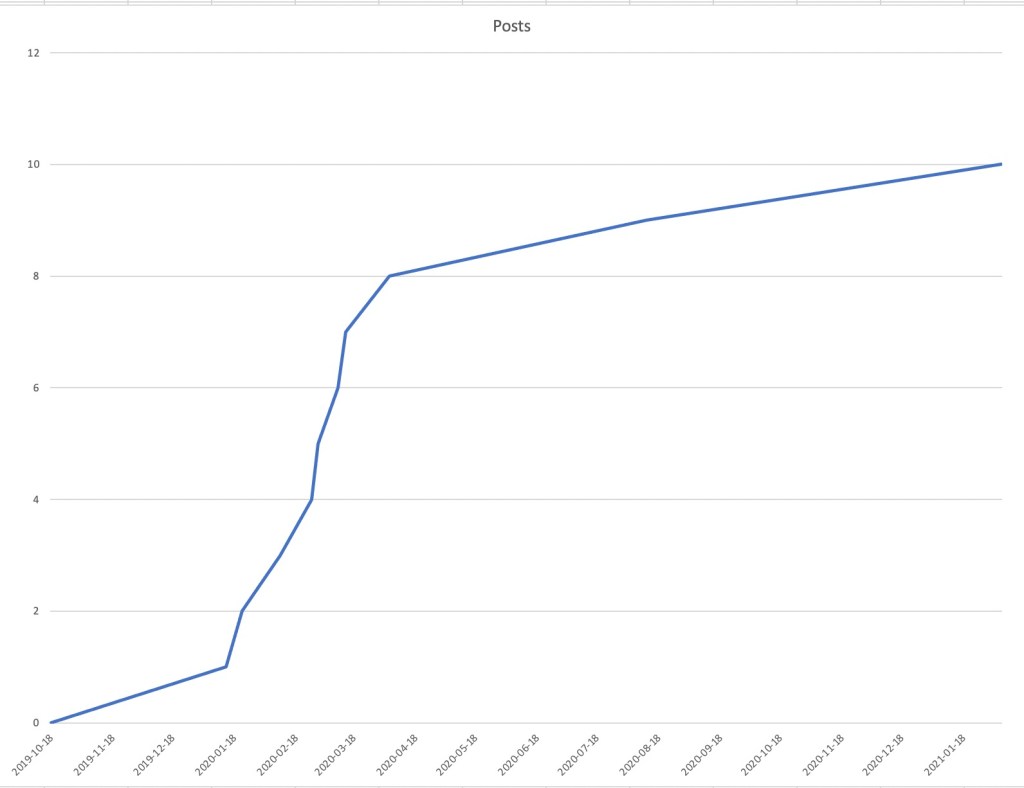
Let’s sketch a timeline. On October 18, 2019, I wrote the very first blog post on this site. The first post in the series On the complexity of change appeared about three months later. Over the last year or so, only 10 posts appeared.

Look how flat the curve became, what’s going on?

And these posts were surely not distributed evenly over the months and weeks of the last 12 months. So, what gives? The timeseries graph depicts a nonlinear developmental trajectory. But I added one post after the other? Sure, but the lagtime between posts varied immensely. The nonlinear order of topics of the nine posts — Intersection of change and complexity > Cynefin: simple and linear problems > Complex problems > Characteristics of complex adaptive systems > Sensitivity to initial conditions > Disproportionate change > Understanding complexity narratively > Example of a chaotic problem > Time in complex adaptive systems — also shows a nonlinear trajectory. Is this something I should be worried about? I sometimes do; and I sometimes don’t.

Let’s look at this series of blog posts through the lens of complex adaptive systems (CAS) by asking three questions: (1) What were the initial conditions? (since we know that CAS are sensitive to initial conditions) (2) What are the growth conditions? (3) Which variables have induced and are inducing change?

What were the initial conditions?

This blog and the Panta Rhei website started off as a good but pretty vague idea. We had a bunch of ideas that we wanted to try out, thought that we had a couple of meaningful things to share, a decent level of computer literacy and of familiarity with online media, but no clear concept of the goal of the whole enterprise and still a lot to learn about blogging, social media, and online presence. In addition to writing blog posts, I worked on the infrastructure of the site, learned a lot from other bloggers, joined a writing group, read up on small online consultancy businesses, took some WordPress tutorials, brushed up on my knowledge about Facebook and Twitter. So, what might not be obvious from the graph above or the ostensible hodgepodge of topics in the series, is that a lot of learning occured. That’s how educator-theoreticians put it, meaning I learned a thing or two on the process, which in one way or another was the main point of the whole endeavor. Up to this point and probably for a little while longer, the main hope I had and still have is that I learn new things and enjoy the journey. Of course, if you find the posts interesting, entertaining, worthwhile, … this is even better.

The initial conditions — a vague idea combined with openess, a lack of experience in blogging combined with a good aptitude and an eagerness to learn, and an unclear focus combined with the strong intent to sharpen it over time — kept recurring in the iterative process of blogging.

What are the growth conditions?

Most complex adaptive systems are open. This means, if you are lucky, there is a constant influx of energy, which influences the complex process. Events external to this blog change the trajectory of the blog. Their energy can induce growth or curtail such growth. The last 12 months have also been the 12 months of COVID-19. Did this divert some of my energy away from the blog? Surely. But it also stimulated my thinking and gave me examples for the discussion of exponential growth, chaotic problems, and nonlinear delopments. Not all growth conditions are external to the CAS. In our case, it have been mainly the “positive” initial conditions, which have turned out to be growth conditions. When I made progress on improving the infrastructure of the site, defined the focus more clearly by moving a couple of posts to my personal blog and transfering some from there to here, the writing got easier and things picked up again. When I learned how to better integrate the blog with its social media, more people became aware of the posts, which in turn increased my motivation.

Which variables have induced and are inducing change?

At first sight, the answer is simple: pretty much anything and everything. Other processes – many of them also complex – impact the process of blogging on the Complexity of change, whether it is the personal life, work, hobbies and exercise. Internally, very little helps and hinders. In one of my future posts, I will take a closer look at how to handle the myriad of variables in any complex adaptive system. And yes, there are a number of ways.

Until then, why don’t you have a look ’round, read or re-read some earlier posts. Let us know what you think.