

Hey, Friend,
Have a very good morning. It’s only 7am. I don’t write at this time. Normally. I should be asking ChatGPT or the other one that got a new name. Gemini. Are there two of them now? Or does the Bard want to be my twin? Don’t smirk; no comment.
I’d rather continue writing about AI. It is more fruitful than writing with AI. Why? There is lots to say and lots to learn. Can you learn from it? Learn from ChatGPT? If you’d like. But it is just form. No meaning. And often we learn from meaning. Are you with me? Time to start at the beginning.

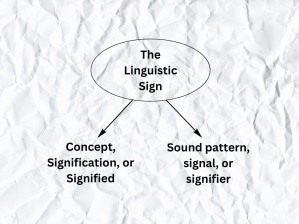
Form and meaning. In language. Let’s take a word. It’s a sign. A linguistic sign. Let’s not get too technical, there is no need for that in the early morning. Linguistic is just language. A linguistic sign is a sign in language. It can be a word. It can be smaller than a word. A meaningful part of it. (Yes, some of you know: it’s called a morph.) It can be larger than a word: a phrase, a sentence, a saying, a paragraph, a text, and yes, a whole novel. Alright back to the word. Like all other signs in language it has form and meaning. The form is material: some ink spilled, a sound wave, dark pixels on your screen. The meaning is not. Not material. This means we cannot sense it. We make sense of it. We cannot hear meaning, we cannot see it with our eyes, we cannot smell meaning, taste it, touch it. We make it. We impute it on the form. It is us who imbue the form with meaning. ChatGPT just gives us forms. Many forms. And quickly. I make the meaning, when I read it. It did not mean anything. (And computer scientists and linguists, AI specialists can tell us that there is a reason for it. But that will have to wait for another post on this blog.) Where were we? The sign. Form. And meaning. More than a hundred years ago, Ferdinand de Saussure told his students that the sign can be drawn as a triangle. An incomplete triangle: the sign on top and nothing at the bottom. Form and meaning at the bottom corners of the triangle and no line – no connection – between them. So, there is no connection between form and meaning? Wrong. There is. Look at the top. The sign. The sign connects form and meaning. And only the sign connects. If the form is not in a sign, it is not connected to meaning. If the meaning is not wrapped in a sign, it has no connection to any form. Who makes these signs? We do. Every day. Every moment. Every time. Every time we use a word or any smaller or larger linguistic sign. It’s use. Meaning is use. The way we use a word, the context we use the word in – that’s its meaning. Alright, it gets quite complex. And ChatGPT can’t do it. Even if Gemini comes to its aid. ChatGPT does not use words (Yes, there is tech behind that, too. Some other time; not that early in the morning). We use the words when we read what the chat says, what it fished out of the Large Language Model. Yes, when we use ChatGPT, we – and only we – make meaning. Conventionally. But conventions is another topic …

 Panta Rhei Enterprise