
What is happening with COVID-19?

On the complexity of change

A colleague cancelled her trip to Italy. She knows the country well and is not afraid of going there. She is afraid of being quarantined, when coming back home to the US. The conference of the American Association for Applied Linguistics with 1,400 registrants in Denver, CO, at the end of March has been cancelled “in light of developments over the last few days” (AAAL, March 9, 2020). Schools are closed in some parts of the world; universities in the US are preparing to take all their courses online until the end of the semester.

Is there a way to make sense of this change, these changes, the angst? I believe there is.

If you have read previous posts or our Team page, then you know that I am neither a medical professional nor a specialist in public health. I watch the international news, care about my own health and that of others, also in other parts of the world, like traveling and (international) get-togethers. And generally, I prefer when I can follow through on a planned course of action. I had planned to buy tickets for the two trips my wife and I want to take in the summer months last week. I didn’t.

How can we make some sense of this complex phenomenon? From what I have read thus far, COVID-19 has not yet been traced back to its initial conditions yet. Why would this be good to know? Generally speaking, because these variables – however minute – are there from the beginning and are often influential at all iterations through which the complex process goes. Unfortunately, misunderstanding initial conditions can lead some people to make decisions that at least appear to be unnecessary. I read recently that the sales of Corona beer are down because of the “namesake” Corona virus; apparently fewer people feel like going to a Chinese restaurant in the US because of the belief that the virus was spread from China.

Not only because I had intended to write about nonlinearity – as an important characteristic of a complex adaptive system – in this post, I will say that understanding the complex global spread of a nasty virus as a nonlinear process is of utmost importance.

Quickly in a nutshell, what does that mean for each one of us?

  • Small changes are likely to have a disproportionately large effect. Washing my hands, avoiding to touch my face, and in general being very careful with hygiene, can and will have the effect that I am better protected from catching the virus and that, if more and more people follow such guidelines (and other measures are taken in concert), the spread of COVID-19 can be contained.
  • Consider the context, learn about the many components, facets, and variables of this complex phenomenon. How is the virus spreading and impacting people in different places of this world? What can its many nonlinear trajectories tell us about its nature? From the little I understand COVID-19 is a relative of the SARS and the MERS viruses. In 2003, I lived in a city close to Toronto, and Toronto was one of the metropolitan centers affected by SARS at the time. SARS had a lower spread worldwide than COVID-19 has already had until now. On the other hand, it had a higher fatality rate (of almost 10%). It passed in about six months. Even with my very limited expertise in things medical this gives me a more rational perspective. It gives me hope and it gives me compassion for other people, people with different fears, people quarantined on a large cruise ship, people with responsibility for large gatherings such as a university or an international conference.
  • Accept the complexity. This acceptance mainly leads me to NOT do something. I do not expect a linear change. Just because we do A – whatever A is – just because the government implements measure A – whatever A is – just because the WHO issues guideline A – whatever A is – I do not expect a direct – linear – outcome B. No single step, measure, cancellation, … will change the course of COVID-19 singlehandedly. All the measures by many different people, bodies, and institutions, our preparedness of making considered – often small – changes, and our mindfulness that continued observation and analysis of the system – of the development of COVID-19 worldwide – are and will be necessary.

Change has the best chance of being sustainable, if it is considered and iterative.

I realize that I quickly glossed over the intricacies of nonlinearity. Well, this gives me a chance to write another post on the topic in the near future and do a better job.

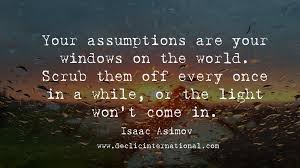
Boundaries – Professional, Part 2: Addendum!

Image result for challenge your assumptions

In a rush to bring a close to an already overly long post last week, I paid short shrift to the Interpersonal aspect of Professional Boundaries. I wrote a bit about establishing and maintaining clarity on the difference between purely social/personal relationships and those of the professional type, but I left out two essential pieces. I will boil them down in this (relatively!) brief addendum: it all comes down to statements and questions.

In my first real job out of grad school, I quickly found myself in a supervisory position where I interviewed, hired, trained, managed and, yes, fired people. Accountability (another staple of the BASE model) was becoming an ever-expanding part of my professional world. One day (a “casual” Friday at that), in our three-person office, my boss was working from home. That left me and my fellow teacher supervisor to our own devices. A re-hire candidate was coming in for a pared-down interview to determine if she would come in to teach again for us that summer. We had it on our shared calendar and thought that meant that our boss was aware and was fine with it.

Later on, when back-briefing him on what we had accomplished that day, we found out that we had been mistaken. The long and short of it was that our boss would have never approved of us bringing any prospective employee in for an interview if he thought we were going to be dressed casually (Friday or not). He was not pleased, and I realized later that it had more to do with the assumptions that had been made (more by my co-worker and me than by him) and the resulting communication breakdown, than with the actual situation of an employee seeing her supervisors in casual clothes. My boss made me keep “Challenge Your Assumptions” as my computer screensaver for the ensuing 12 months. The phrase, and the lesson it was meant to teach, has unsurprisingly stuck with me.

What it has to do with today’s post is simple. We often make not-so-good assumptions about the importance of differentiating between our statements and our questions in interpersonal interactions in the workspace. The other day, I heard about an employee who will soon be leaving a workplace, and as such is having some responsibilities transferred to other colleagues. When one of those colleagues got together with this person to discuss the details, the soon-to-depart employee at one point exclaimed, “I’m not gone yet and this is still my responsibility!” Their interaction went downhill from there.

As soon as I heard this story, an empathetic smile came to my face. This person has a question, whether they realize it or not. What happened? A statement was made, and to the wrong person at that. This employee, somewhat understandably given the stress associated with leaving a job, failed to challenge assumptions about how the transition would be handled, and as such made a statement to a colleague when a question directed to the supervisor or manager was what was most needed to clarify things. So, to keep this as short as I can, here’s the upshot: do your best to have clear Professional Interpersonal Boundaries around your statements and your questions in the workplace. This is likely to require active challenging of many of your favorite assumptions, but that’s almost never a bad thing. At worst, you come to the conclusion that your assumptions were good. At best, you save yourself (and your co-workers) some embarrassment and grief.

This leads me to the second thing: questions. Everyone knows how to ask them, right? But, how many of us can claim a high level of clarity and confidence that we most often ask the best kinds of questions in the most important work conversations? Count me as one of the people who can’t always make that claim. But, maybe you’re reading this and aren’t even sure what the heck I’m talking about. Let me try to clarify.

In his 2013 book “Humble Inquiry: The Gentle Art of Asking Instead of Telling,” celebrated Organizational Culture/Behavior/Psychology expert Edgar Schein lays out exactly why questions, and being very clear on when to they are superior to statements, matter so much. He writes:

“How can we do better? The answer is simple, but its implementation is not. We would have to do three things: 1) do less telling; 2) learn to do more asking in the particular form of Humble Inquiry; and 3) do a better job of listening and acknowledging.”

Simple, right? No, of course not. Schein already told us it isn’t simple at all. So what does it mean? He says we should “do more asking in the particular form of Humble Inquiry.” But what is that? Well, to paraphrase Schein, it’s finding the opportunity in any given interaction or conversation to be genuinely curious about something that is being said or communicated, and then asking a good question (i.e. NOT one whose answer we think we already know) about that something in which we are truly interested in learning more. Still not simple, I know, but at I hope least somewhat clearer.

So, what now? Well, for this week (and well beyond, if you like), perhaps just try paying more attention to the frequency and type of statements and questions you notice in your workspace, both yours and those of others. If you are a formal authority figure, let me suggest you REALLY pay more attention to this, but I advocate strongly for it no matter your position.

As you pay more attention, look for opportunities to turn a statement (one of your own or one you notice) into a question. Once you have a handle on that, try to turn it into a Humble Inquiry-type question. Want an example? Let’s go back to the situation I outlined earlier: “I’m not gone yet and this is still my responsibility!”

What kind of question can that become? In the moment, talking with a co-worker, perhaps something like “Did (our supervisor) say that you were to take this over effective immediately, and would it be alright with you if we went and asked (our supervisor) for clarification?”

Either or both of those might work, no? I am confident that the interaction would have been less likely to go south (as it did in reality) had either or both of those questions been asked in place of the statement that was made. Especially if they had been asked with an authentic tone of curiosity and interest. I wonder (genuinely) what you think.

Remember, comments are welcome on this blog. Feel free to post a reaction, a question, or an anecdote of your own. Mat and I will be happy to read them and respond whenever we can!

Boundaries – Professional, Part 2: Office Space Is A Function Of Our Head Space: How to stay motivated and make sure you’ve always got the memo …

Take a moment and watch this, even if you’ve seen it many, many times before. This time, watch it with an eye and a mind for cognitive and interpersonal boundaries in the professional context. Be prepared to look, somewhat critically, at the kind of thinking and interacting that is going on, and how the boundaries that are in place for the protagonist, Peter, are involved:

Look for the cognitive and interpersonal boundaries that define Peter in this space…

What did you notice? Just make a mental, or written, note of it for the moment. Now, watch this clip and do basically the same thing:

Now what cognitive and interpersonal boundaries are at play for Peter?

So, what changed? Go beyond the narrative device(s) utilized in the movie, and just think about what could have gone on within Peter in terms of his thoughts and interactional decisions vis-à-vis the workplace. It’s quite something when you stop and look at it with a different lens…

In today’s post, part two on Professional Boundaries, I will once again outline a couple key elements of Professional Cognitive and Interpersonal Boundaries, much as I did for the Temporal and Kinetic aspects in part one.

Cognitive Professional Boundaries can cover a lot of territory. There are so many things to think about at work, around work, between yourself and “the work.” For my money, though, it mostly boils down to a couple of main things: 1) Your relationship to authority in the work context, and 2) the way you think about tasks in your workplace. Let’s begin with your relationship to authority…

For most people in the workplace, “authority” begins and ends with positions, titles, and so-called hierarchical org charts and corresponding work-flows. I’ll not dispute that in many work environments this is (or strongly appears to be) the law of the land, but I will assert that it is (almost) never as much the case as it appears to be.

Yes, supervisors, managers, and all-around “bosses” wield a certain amount of formal authority that can be neither avoided nor denied. But, do you automatically fold your tent or change your overt point of view when it doesn’t align with whatever the “boss” is saying? If so, I must simply ask you to consider why that really is. I mean, I get it, sometimes it is downright dangerous to disagree with a supervisor, manager, or other “boss” monster-type. Yes, you do need to read the terrain well in order to decide when it is acceptable to be a voice of disagreement or even dissension. You also have to do your homework. Nobody wins points for having the courage to disagree in an uninformed manner.

So often, the tasks we perform at work are tied to a dry, frequently outdated, job description that was written more to make sure we could be held accountable in the event of underperformance than to offer us pathways to success and growth. As a result, all too often we restrict our professional enthusiasm and working passion to those rare opportunities we are given (note the use of passive voice there) to step outside of those constraining job responsibility boxes and take on a special, usually temporary, new task. And once that special task or project ends, we return to our cubicles (real or imagined) and resume our business-as-usual routines. We resume a posture where all our real authority and light is dampened by a self-protective stance, doing just enough work, as Peter would say, to not get fired. Oh, we probably tell ourselves a different story about it. I’ll even grant that many of you reading this are doing much more than that notional bare minimum, but… is it really your best? And if it isn’t, why not? Really. Why not?

Is it your boss’s fault that you don’t consistently put your best work forward? Is your compensation rate truly to blame? Is it your competitive/counterproductive/challenging colleague’s fault? Is it because you haven’t been vested with the kind of positional, formal authority that you (and sadly most people) view as pre-requisite to being fully enabled to unleash all your talents? I mean, come on…

What if you could seek to embody and exercise a different kind of authority? What if your threw all your extra energy and focus at work into identifying right actions, tasks, and solutions for as many relevant issues as possible? What if you worried more about doing what is needed than what is “right” or “fair” in your, or someone else’s, highly subjective point of view? It’s risky terrain to navigate, no doubt.

But if you can change the way you think, actively challenging all your most embedded assumptions about what work owes you and what you owe work, you may find that a different kind of authority, the kind Ronald Heifetz and others in leadership studies call “informal,” can become yours to wield. Understanding, and learning to engage with, the part of yourself that is authoritative and solution-oriented, irrespective of your position or title, is as close to a fool-proof pathway to professional success and fulfillment as I can think of.

And it all starts with mastering your thinking around what authority really is for you, and what purpose it really serves. Professional growth then extends to how you can apply that thinking not just to the tasks that land on your proverbial “desk,” but also on those that face your entire workplace team and/or organization. Rare indeed are the stories of people who got bumped up in responsibility or pay, or who reported feeling more fulfilled, by having the firmest handle on what their job wasn’t…

Interpersonal Professional Boundaries are the trickiest to capture and make meaningful change within. Work relationships, as discussed at length above, are often driven by the almighty org chart, workflow, or by the prevalent culture in a given place of business. Haves and have-nots emerge and we all behave accordingly or we move on to a different job.

There are, however, a few things I believe it is important to keep in mind. They mostly center around what I see as the erroneous, and even dangerously misleading use of words like “family” and “friends” in the workspace. Before you close this tab, deeply offended that I dared to disparage the great familial environment that exists at your work (and that you may have perhaps even helped to create), bear with me for a few moments more.

While friendly and familial relationships are no doubt the great joys of most of our lives, are they always only joyful? The answer, of course, is “no,” or at least “probably not.” They swing and cut both ways. Sometimes they are the most volatile kinds of relationships we can have. Is this really the kind of thought and feeling process that will serve us best at work? I’ll just come out and say that I firmly believe the answer to be “no.” This is especially true if you hold a position of formal authority.

Certainly, there are cultures outside the so-called “West” where the expectation is precisely that bosses, subordinates, peers and co-workers will treat one another as if they were friends and family (many times because they actually are!). However, in the context of the U.S./North American workplace, and in the ever-more globalized professional landscape, the safest bet is to establish and maintain interpersonal professional boundaries that are driven and informed by mission, tasks, work, and shared professional values.

I hope you found today’s post helpful, or at least interesting. Check out part 1 on Temporal and Kinetic Professional Boundaries if you missed it, and/or read parts 1 and 2 on Personal Boundaries. If you want the broadest of strokes, have a look at my introductory posts on the BASE model and Boundaries as its first component.

Finally, I hope you’ll spread the word about this blog and check back next week for my first post on Physical Boundaries. Most importantly, whatever you do, or don’t do, infuse it with intention and conviction.