
GenAI and the future of language teaching

A prediction about the future of language teaching when GenAI is rapidly evolving? That’s tough.

Predictions are difficult, especially about the future. Usually Niels Bohr is credited with this bonmot. Apparently, it was the Danish politician Karl Kristian Steincke who said it first: Det er vanskeligt at spå, især når det gælder fremtiden.

We are more trying to explore how language teachers can begin to shape the future of language teaching with GenAI.

A little while ago, I wrote an article with Phil Hubbard on “AI and the future of language teaching – Motivating sustained integrated professional development (SIPD)” for the International Journal of Computer Assisted Language Learning and Teaching. I am copying this grand title for this blog post. The article is published as ‘open access’, which means you don’t need a subscription to read it at https://www.igi-global.com/gateway/article/full-text-html/378304.
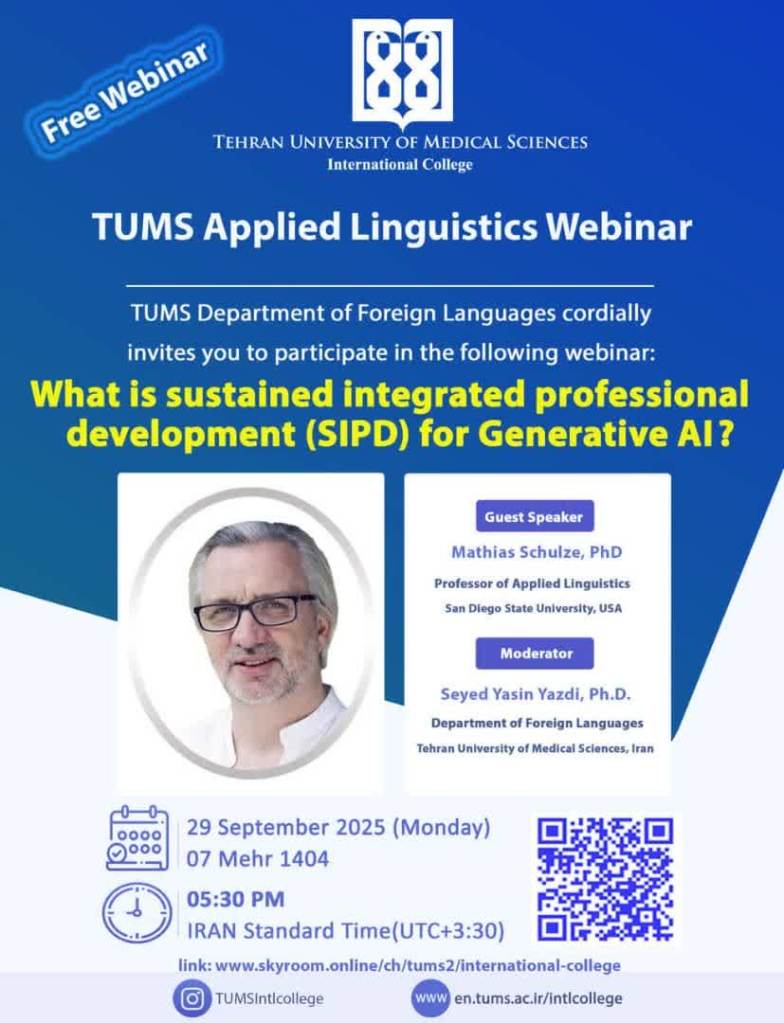
You are hereby cordially invited to participate in the following webinar organized by the Foreign Languages Department of Tehran University of Medical Sciences. Poster of the TUMS APPLIED LINGUISTICS WEBINAR SERIES II (Session XXVIIi)
Webinar: What is sustained integrated professional development for Generative AI? Monday, 29 September, 2025 @ 7am (Pacific time) https://www.skyroom.online/ch/tums2/international-college

This article will be the basis for the free webinar (poster above) on Monday, September 29, 2025, at 7:00 in the morning (I will get up early and have my coffee before then.). 7am Pacific – 10am Eastern – 3pm British – 4pm Central European – 5:30pm Iran – 11pm Japan.

I will also follow up on the topic with some notes in this blog.

Let’s talk about AI …

Generated in WordPress

Artificial intelligence has been a topic on this site. This is not surprising to people who know a little about me. I started learning about natural language processing and – a little later – about student modeling in 1995, when I began to work at the Centre for Computational Linguistics at UMIST. All three – natural language processing, student modeling , and computational linguistics – are part of artificial intelligence research in their different ways. Over the last many months, I started learning more about generative AI and how it impacts education and especially language education. I have now completed drafts for two book chapters. I have started splitting them into smaller parts and edited them slightly. I hope you will find them interesting. The first part is up. Let me know you think this academic writing is working on a blog.

AI, AI, AI, …

Photo by Christina Morillo on Pexels.com

Hey, Friend,

Zooming in on one topic … A complex topic. Actually … zooming out. Trying to grasp the big picture. At least to get an idea. Artificial intelligence. What do we need to think about when we think about AI?

Let’s make a list. It’s the internet, why not add another list? What am I thinking about when I think about generative artificial intelligence? It already took a few posts to get a little closer to this phenomenon of AI. And I am mostly interested in AI in language education.

  1. This machine is impressive and frightening …
    How does GenAI work? What’s under the hood?
  2. This came out of the blue and all too sudden …
    Where did GenAI come from? Why now? How come it’s so big?
  3. The machine is my servant — the machine is taking over …
    What happens when we use it? How do we interact with it?
  4. I can achieve so much more — the machine is taking my job away …
    What are the long-term effects? And what happens in the short term?
  5. The power of human reason — robot power …
    To what should we pay attention and what can we ignore?

This will take a couple more posts … and some time to think.