This is part of a draft of an article I wrote with Phil Hubbard. He was the main writer of this part. In this paper, we are proposing a way in which teachers can organize their own professional development (PD) in the context of the rapid expansion of Generative AI.
We call this  PD sustained integrated PD (GenAI-SIPD). Sustained because it is continuous and respectful of the other responsibilities and commitments teachers have; integrated because the PD activities are an integral part of what teachers do anyway; the teacher retains control of the PD process.

The full article is available as open access:
Hubbard, Philip and Mathias Schulze (2025) AI and the future of language teaching – Motivating sustained integrated professional development (SIPD). International Journal of Computer Assisted Language Learning and Teaching 15.1., 1–17. DOI:10.4018/IJCALLT.378304 https://www.igi-global.com/gateway/article/full-text-html/378304
In our context, the term professional development (PD) describes activities engaged in by language teachers after completing their initial formal training (Shawer, 2010). It encompasses a wide range of options. Under the umbrella of continuous professional development, Vadivel et al. (2021) note, “It is a long-term learning process, which is crucial in keeping abreast with the modern changes and developments in the teaching world. There are many ways to develop professionally, either through degrees, courses, workshops, training, or seminars” (p. 2). We do not consider degree programs here, and our target is not professional development across the board (as important as that is) but only in relation to GenAI. We focus on the more targeted PD options, which are often provided by outside experts on-site, online, or during professional conferences. However, Buendía and Macías (2019) observe, “A recurring problem with these one-shot in-service programs is that the knowledge gained is generally disconnected from the teachers’ actual contexts and reality in both practical and conceptual terms” (p. 90).
To counter that problem, a number of PD models and associated principles have been developed. For instance, Darling-Hammond et al. (2017) analyzed 35 empirical studies of successful PD programs, identifying seven common design elements.
- They are content focused.
- They incorporate active learning strategies.
- They engage teachers in collaboration.
- They use models and/or modeling.
- They provide coaching and expert support.
- They include time for feedback and reflection.
- They are of sustained duration. (p. 23).
Looking at our GenAI context, for (1), being content focused means that the PD tasks and activities are directly tied to the content and curriculum of the teacher’s language class. The objective is to spend GenAI PD time toward improving the life of the teacher (by measures such as saving time, improving job satisfaction, etc.) and increasing the effectiveness of the language learning experience for the students. For (6), teachers may or may not have access to feedback. This is especially the case if they are relying on non-interactive webinars, prerecorded material, or texts. However, teachers can make time, even a brief time, for reflection. GenAI was not around when most practicing teachers went through their formal training programs. It is thus crucial for teachers trying to understand and appropriately integrate GenAI into their teaching to do so reflectively. Keeping a “GenAI journal” to document this journey is strongly advised. Finally, the notion of sustained duration is crucial for us. The pace at which GenAI has entered our lives is astonishing, and it continues to accelerate. Accordingly, ongoing professional development is becoming a core, continuous element of teaching practice and lifelong professional learning.
Interestingly, design elements (1), (6), and (7) from Darling-Hammond et al. (2017) are also found independently in Matherson et al. (2014). Building on a technological pedagogical content (TPACK) model, they note, “For teachers to overcome shortcomings pertaining to technology use in the classroom, they must be presented with ample professional development opportunities that are embedded in school and classroom practices, sustained over a period of time, and include opportunities for reflection” (p. 48). This view resonates with ours in that it includes the key elements of being sustained, embedded, and reflective.
Before continuing, let us clarify what we mean by sustained and integrated.By integrated we mean it is a part of the regular activities of a language teacher. Where GenAI is concerned, every encounter with it in designing and implementing courses, lessons, tasks, assessments, and so on is a potential PD activity. Determining whether and how to incorporate GenAI is a PD activity. Guiding and monitoring student use is a PD activity. Shifting the GenAI role from tool to collaborator (Pratschke, 2024) is a PD activity. GenAI PD thus becomes ubiquitous in the life of a language teacher, not something solely encountered during workshops, webinars, or conferences. Similarly, by sustained we mean not just occurring in the course of some project, teacher research study, or one-off GenAI experience, but rather daily, or at least quite regularly, throughout an extended time. Ideally, awareness of and critical reflection on GenAI and ultimately other forms of AI for language teaching and learning becomes habitual. There may come a time when GenAI is normalized, fully a part of a teacher’s everyday life and no longer exceptional (Bax, 2003), but that time is not in the immediate future.
Provisional Principles of GenAI-SIPD
Richards (1996) notes that teachers work from principles or “maxims” in their own teaching practice rather than from abstract theoretical frameworks. Thus, we present this guidance in the form of principles because we want it to be clear and actionable so that teachers can use it independently to support their own evolving GenAI autonomy. Teacher autonomy has been a central notion in CALL for some time. For example, Kessler (2010) notes that “the ability to utilize, create, and manage CALL environments for integrated language skill development is a critical foundation upon which CALL teacher autonomy rests” (p. 378), and we believe this is as true as ever in the AI era. Teacher educators, more advanced peers, and institutional authorities can and should share responsibility for supporting teachers in their GenAI journey, but it is ultimately the teachers themselves who need to learn, integrate, and sustain their new skills and knowledge.
Below, we propose seven provisional principles to support teachers’ GenAI-SIPD. We emphasize provisional because while drawn from previous work in computer-assisted language learning and other educational domains, they have not been tested within the GenAI context.
- Understand the basics of GenAI to make informed use decisions. Making an informed decision requires having a stock of relevant information to start with and enough of an understanding to know where and how to seek additional information as needed. One objective of this paper has been to provide a foundation regarding AI and GenAI to address this point for language teaching. The details in the first part of the paper and following through on exploring the sample topics and resources will go a long way toward meeting this principle. Importantly, “the basics” are not static. We have witnessed remarkable changes in the past few years and will continue to do so. A corollary of this principle is thus to revisit this foundational understanding regularly and add to it over time.
- Experience GenAI as a language learner. There are three parts to this principle. The first involves a teacher taking the role of a true language learner, using one or more GenAI applications to engage in activities to support learning a language you do not already know well. Repeat this over time with a variety of tools to get a solid foundation of learner experience in the GenAI era. The second involves taking any GenAI-mediated assignment or classroom activity you might give and running through it assuming the role of the student to see if the GenAI is doing what you expect it to, making any necessary adjustments. The third is to share your GenAI experiences with students and encourage them to share with one another as well.
- Start small and look for uses of GenAI that have immediate value for your current teaching context. As per Puentedura’s (2006) Substitution, Augmentation, Modification, Redefinition (SAMR) model, perhaps begin with substitution. Find existing tasks or activities that look promising in terms of increasing efficiency or effectiveness and try using GenAI as a tool to improve them. Also, be aware that different instances of GenAI integration may take different amounts of time, but that more complex uses may be broken down into smaller elements (Cheng et al., 2015).
- Think of GenAI-SIPD as GenAI “sipped.” These “sips” are small amounts of time and energy devoted to GenAI-SIPD. Engaging in these microlearning experiences regularly, making them habitual, and reflecting on them is going to be the most likely way for many to make “sustained” into “sustainable” Kohnke et al., 2024). We understand that practicing teachers do not have the time available to explore new ideas the way teacher candidates in formal courses can, but even a few minutes a day can make a difference. Try to integrate these “sips” into a practical plan for GenAI-SIPD while keeping your own welfare in mind. Document the time spent and lessons learned to engage more deeply and enhance motivation. Here, using GenAI can be compared to daily physical exercise and its positive long-term impact.
- Evaluate AI options critically and reflectively. Whatever the language learning goals, it is important to ascertain that a given instance of GenAI use will support them. In particular, it is essential to recognize the difference between GenAI supporting completion of a task vs. supporting learning and language development. First, think through the opportunities and challenges of a particular use of GenAI before using it. Then, if relevant, try it on yourself and monitor what it is like from the learner’s side. Finally review the results critically and decide whether you would use it again and if so, what you might change. This is consistent with Schön’s (1983) teaching cycle of reflecting for action, in action, and on action.
- Always consider ethical issues in your and your students’ GenAI use. Ethical considerations are a critical part of using GenAI because of its novelty, power, and opaqueness (Ohashi & Hubbard, 2025). Be aware of issues such as factual and linguistic accuracy, social and cultural bias, privacy and data security, and transparency in when, how, and why GenAI is being used. Be aware of institutional guidelines for acceptable student and staff use or adopt, adapt, or create appropriate ones of your own. These are not entirely new ethical issues for language teachers since many have been around since the Web allowed teachers and students direct free access to resources like digital media and machine translation.
- Seek out and nurture partnerships with peers. Although GenAI-SIPD is possible to do on your own, it is easier and more motivating to work and learn with others. The value of a community of practice (CoP) has long been recognized for professional development in general (Lave & Wenger, 1991) and for CALL specifically (Hanson-Smith, 2006). It can be as simple as connecting with one or two other teachers in your program, or it can involve more formal communities such as the AI interest groups of EUROCALL and CALICO. Look for opportunities both to learn from peers and to share your own skills and knowledge with them, locally, in your teacher association, and, if you can, in international organizations. Here GenAI becomes the common ground for fruitful conversations among professionals.
References
Bax, S. (2003). CALL—past, present and future. System, 31(1), 13–28. https://doi.org/10.1016/S0346-251X(02)00071-4
Buendía, X. P., & Macías, D. F. (2019). The professional development of English language teachers in Colombia: A review of the literature. Colombian Applied Linguistics Journal, 21(1), 93–106. https://doi.org/10.14483/22487085.14135
Cheng, J., Teevan, J., Iqbal, S. T., & Bernstein, M. S. (2015). Break it down: A comparison of macro- and microtasks. Proceedings of the 33rd Annual ACM Conference on Human Factors in Computing Systems, 4061–4064. https://doi.org/10.1145/2702123.2702146
Darling-Hammond, L., Hyler, M. E., & Gardner, M. (2017). Effective teacher professional development. Learning Policy Institute.
Hanson-Smith, E. (2006). Communities of practice for pre- and in-service teacher education. In P. Hubbard & M. Levy (Eds.), Teacher education in CALL (pp. 301–315). John Benjamins.
Kessler, G. (2010). When they talk about CALL: Discourse in a required CALL class. CALICO Journal, 27(2), 376–392.
Kohnke, L., Foung, D., & Zou, D. (2024). Microlearning: A new normal for flexible teacher professional development in online and blended learning. Education and Information Technologies, 29(4), 4457–4480. https://doi.org/10.1007/s10639-023-12074-6
Lave, J., & Wenger, E. (1991). Situated learning: Legitimate peripheral participation. Cambridge University Press.
Matherson, L. H., Wilson, E. K., & Wright, V. H. (2014). Need TPACK? Embrace sustained professional development. Delta Kappa Gamma Bulletin, 81(1).
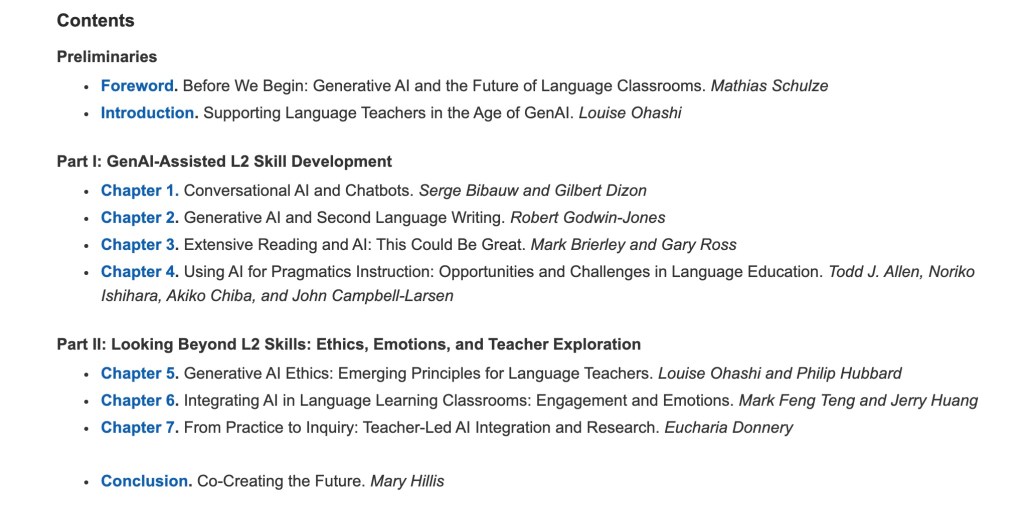
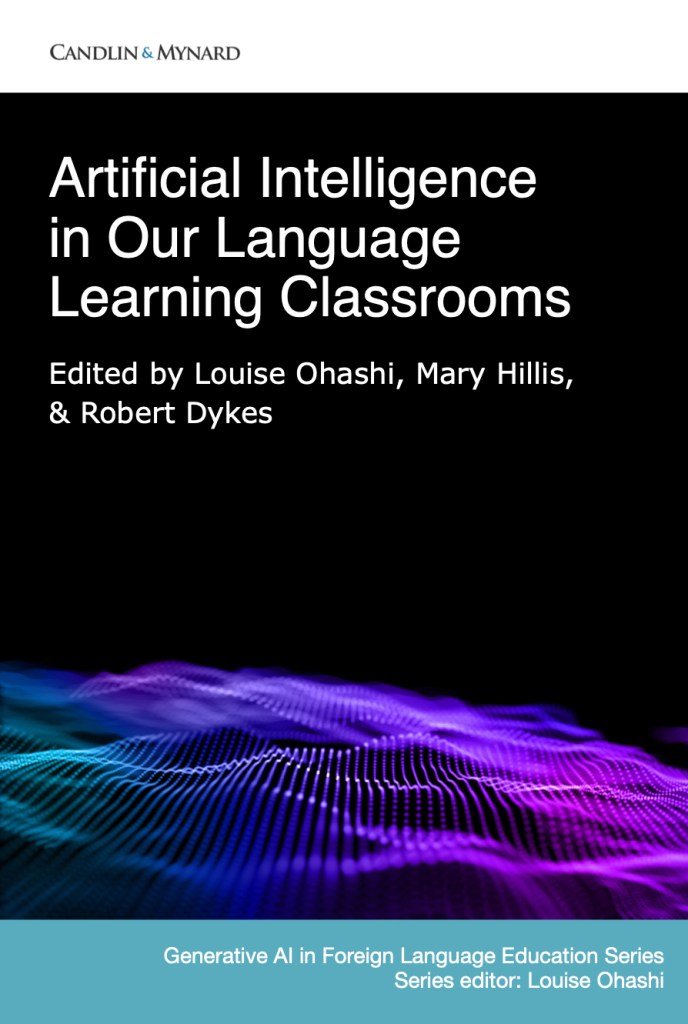
Ohashi, L., & Hubbard, P. (2025). Generative AI ethics: Emerging principles for language teachers. In L. Ohashi, M. Hillis, & R. Dykes (Eds.) Artificial intelligence in our language learning classrooms. (pp. 100–125) Candlin & Mynard ePublishing. https://www.candlinandmynard.com/ohashi_hubbard.html
Pratschke, B. M. (2024). Generative AI and education: Digital pedagogies, teaching innovation and learning design. Springer Nature.
Puentedura, R. (2006, August). Transformation, technology, and education. http://hippasus.com/resources/tte/
Richards, J. C. (1996). Teachers’ maxims in language teaching. TESOL Quarterly, 30(2), 281–296.
Schön, D. A. (1983). The reflective practitioner: How professionals think in action. Basic Books.
Shawer, S. (2010). Classroom‐level teacher professional development and satisfaction: Teachers learn in the context of classroom‐level curriculum development. Professional Development in Education, 36(4), 597–620. https://doi.org/10.1080/19415257.2010.489802
Vadivel, B., Namaziandost, E., & Saeedian, A. (2021). Progress in English language teaching through continuous professional development: Teachers’ self-awareness, perception, and feedback. Frontiers in Education, 6, 757285. https://doi.org/10.3389/feduc.2021.757285







 Panta Rhei Enterprise