A prediction about the future of language teaching when GenAI is rapidly evolving? That’s tough.
Predictions are difficult, especially about the future. Usually Niels Bohr is credited with this bonmot. Apparently, it was the Danish politician Karl Kristian Steincke who said it first: Det er vanskeligt at spå, især når det gælder fremtiden.
We are more trying to explore how language teachers can begin to shape the future of language teaching with GenAI.
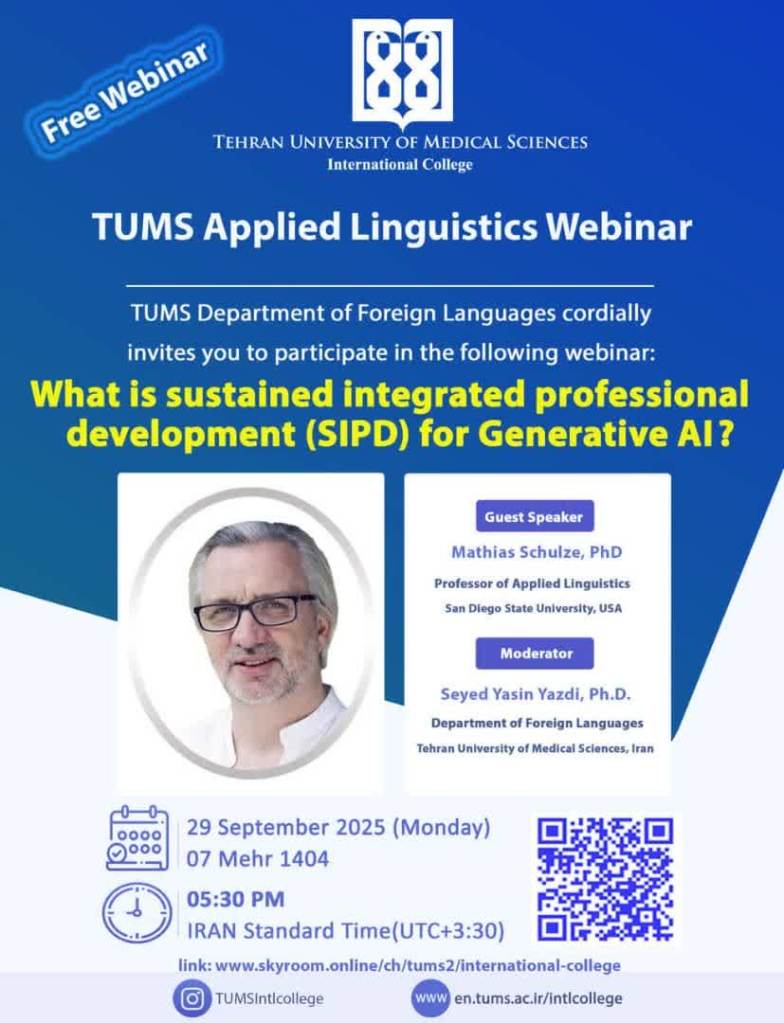
This article will be the basis for the free webinar (poster above) on Monday, September 29, 2025, at 7:00 in the morning (I will get up early and have my coffee before then.). 7am Pacific – 10am Eastern – 3pm British – 4pm Central European – 5:30pm Iran – 11pm Japan.
I will also follow up on the topic with some notes in this blog.
It feels like the chatter about AI (as they say, when most people mean generative AI only) seems to be as vast as the ocean … And that is a good thing; we are dealing with a complex rapidly moving challenge-cum-opportunity.
For the last 30 or so years, I have been working with computers. When working with machines, input is an important concept. In the nineties, I read, heard, and thought a lot about input in the context of language learning and in – what Stephen Krashen called – language acquisition. I struggled with his input hypothesis and his no-interface hypothesis. In all discourses after that, researchers in Applied Linguistics and trained language teachers focused their attention on more applicable and theoretically better founded concepts. In other words, all quiet at the input front … until recently when I started working in the world of teaching of languages labeled less commonly taught, heritage, community … and often also – in the US – critical and strategic. Here it re-appeared; comprehensible input, the whammy of the 1970s and 1980s, is left, right, and center in these classrooms and discussions. So, how come, and why am I worried about it?
Input is a metaphor that has been borrowed from the world of machines. Machines receive input, and then, if you are lucky, they produce output. For humans, we do not talk about input when we eat, when we breathe, when we drink. Why would anybody want to do this when we listen or read? Why would language teachers conceptualize language, texts, utterances as input for their students? I really don’t know. What I do know is that my students are not machines that I need to feed with input so that they produce output. Language learners are multilingual subjects, which implies that they have – what theorists call – agency. They make their own decisions what text or utterance they take in and which ones they do not; and they decide whether to say anything and what it is they are saying. Only for a machine, some input will trigger some output.
But perhaps the meaning core of ‘comprehensible input’ is in the adjective? I am not sure. I find that ‘comprehensible’ is not very comprehensible [pun intended]. So, teachers want to expose their students to some language, which they in turn can learn; but how do teachers make these texts comprehensible?
There are two main strategies – appropriate selection and pedagogic augmentation – and neither one can just be derived from the concept of comprehensibility. Appropriate selection: Teachers select linguistic units – words, constructions, sentences, paragraphs, and texts – that are relevant to the students’ learning and their current or future life contexts, so that they are motivated to engage with them. Teachers select these linguistic units such that they optimally impact the language use of their students by selecting texts that reflect current language usage in a variety of genres, give priority to vocabulary, grammatical constructions, and communicative functions that their students will need in realistic interactions in the language they are learning. Teachers select the same building blocks – words and grammatical constructions – as frequently as is needed by their students and pay attention that these words and grammatical constructions are repeated in different contexts, that is in different places in a sentence, in different texts, in different genres, and both spoken and written. Students need to encounter these words, constructions, sentences, paragraphs, and texts repeatedly in chunks that are conducive to language learning. Sometimes pauses need to be left between words (each word is such a chunk), sometimes students need to have the chance to study a sentence word by word, sometimes a text can be better understood if read paragraph by paragraph, a video clip might have to be interrupted a couple of times, so that students can iteratively engage with each chunk.
Selecting appropriate texts is necessary, but it is not sufficient. Since most texts that teachers select contain material that is new to the students, the (linguistic) information contained in the text needs to be augmented. In other words, information needs to be added. How? Each text contains parts that are less salient, which means students – or anybody else for that matter – will find it more difficult to notice them. Well, and if we do not notice something, our chances of learning it or learning about it are pretty slim. Grammatical features such as prepositions or, in a number of languages, verb inflections are very difficult to notice because they are not always salient. Augmenting means here making them more salient. In a written text we use graphical means (underlining, color-coding, bold-face print, …) and in spoken texts we use sentence and word stress, intonation, and pauses to make the words and constructions we want students to notice stand out. Multimodality is the second important concept when it comes to augmenting texts to which language learners are exposed. When a text is presented just as such it is in one mode – printed or spoken – only. The students have to rely on only one “channel.” Providing captions for a listening text or reading aloud a text students also have in front of them gives them the same information through two “channels.” Even better if the text is accompanied by pictures or a video. This redundancy – information being given more than once – is very useful for cognitive processing and hence (language) learning, particularly if the information is in different modalities – printed, spoken, pictorial, video. As providing the information in different, complementary modalities augments the text from which the students are supposed to learn something, so does additional linguistic information. The most obvious ways of scaffolding the students’ understanding of a text are providing monolingual or bilingual glosses or captions, the use of a dictionary. The same also works for grammatical features – word morphology and syntax – with the help option to look up declension and conjugation tables. Online texts can have the additional functionality of providing the base form for each infected form. In a language like German it is difficult to distinguish between proper nouns and other nouns because they both have a capital initial letter. The opportunity of looking up who Kohl, the former Chancellor of Germany, was, as opposed to looking up the word Kohl in a dictionary and finding out it means ‘cabbage’ means learners do not get distracted from the actual language learning.
Of course, there would be more that could be said about selecting and augmenting texts for learners, and other strategies can and should be used. So, is it really better to replace one phrase – comprehensible input – by a set of strategies?
selecting utterances, constructions, words which are necessary to learn, relevant to the learners’ cultural, social, and biographical contexts, and pedagogically appropriate;
selecting texts that are socially relevant and that reflect current, appropriate language usage in the speech community of the learned language;
repeating linguistic units frequently and in different textual, communicative, and genre contexts;
making the texts and smaller units teachable by chunking them appropriately, that is breaking them up into a pedagogic sequence of smaller parts;
augmenting texts by
making the words and constructions that are in the teaching focus stand out (saliency);
exposing learners to multimodal texts – combining text, picture, animation, video, gestures effectively to help them notice new information and obtain through different channels;
providing the necessary (meta-)linguistic help and scaffolding so that learners can handle the new texts successfully.
I realize it took me far more words than just a simple phrase to express what I think is necessary when exposing learners to examples of how the language they are learning is used. Well, I would think sometimes more really is more. In my experience, teachers find it much easier to apply this detailed information in their daily classroom practices. Admittedly, many of these strategies also get listed when teacher developers or trainers explain ‘comprehensible input’, but why use a machine metaphor first and potentially lead them down a garden path, when you can start with practically applicable strategies?
I had posted this on my personal website in April 2018. Now it is the last post that I am transferring to this blog. Promise: future posts will be new, now that everything has been tidied up. (October 30, 2020) I am reposting this in 2025.







 Panta Rhei Enterprise