From late 2022 to early 2025, several LLM-based chatbots were released, such as ChatGPT, Claude, Gemini, Qwen, Llama, and DeepSeek. All of them can generate conversational responses with remarkable linguistic accuracy and contextual appropriateness and at almost turn-taking speed. Such chatbots can be prompted to adjust the proficiency level of the output to the learner (but see Uchida (2025) for the challenges with adjusting for CEFR levels) and can stick to the desired topic and only use appropriate vocabulary. This way, these chatbots are far superior to those of early applications of AI and especially NLP in CALL (Schulze, 2025).
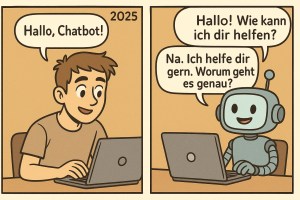
German chatbot. Generated by ChatGPT 5 as an illustration
Is a conversation with a chatbot the same as a human conversation? LLM-based chatbots have been compared to “stochastic parrots” (Bender et al., 2021), parrots that produce plausible utterances by chance. The computational linguists Bender et al. (2021) stated that
coherence is in fact in the eye of the beholder. Our human understanding of coherence derives from our ability to recognize interlocutors’ beliefs … and intentions … within context … That is, human language use takes place between individuals who share common ground and are mutually aware of that sharing (and its extent), who have communicative intents which they use language to convey, and who model each others’ mental states as they communicate (p. 616).
For language learners, this means that it is on them to control and steer the conversation with the machine. What they say – their prompt – determines what the machine says much more so than with a human interlocutor, who will reason about the student’s intention, which is ‘underneath’ the utterance. The machine will calculate the probability of subsequent word forms. The problem is compounded by the chatbot’s attempt to keep the conversation engaging with immediate questions, which makes it more difficult for the learner to steer the conversation. Similar challenges are to be considered in the other direction: the learner’s understanding of the generated text. Chatbots generate plausible texts that correspond to the student’s input because of highly sophisticated pattern matching processes; chatbots do not generate meaning. We, however, are used to decoding meaning from text. So, it is the learner imbuing the text with meaning when reading the machine output. Students are using their world knowledge, their linguistic capital, and their contextual awareness for interpreting the machine’s output. This is normally based on the human assumption that the chatbot “understood” the prompt. However, machines do not understand text in the way humans do – Hariri (2024) prefers the term alien intelligence for AI, because of their way of processing being radically different – they conduct a fast, sophisticated mathematical analysis and then generate a matching piece of text based on their pre-training. This interaction is akin to that with a calculator, which also cannot understand mathematics and can calculate accurately at great speed. Calculators are faster than humans and are more consistent without making mistakes, and so are LLM-based chatbots in both understanding and generating. So, chatbots have the advantage of speed, accuracy, consistency, and task focus – all without fatigue or stress. Yet, they are lacking in emotional intelligence, awareness of the situational context, and personal memory, for example, of similar conversations with the same person in the past.
Individual conversational practice with a GenAI chatbot is feasible and practical within the context of second-language development. Students are exposed to rich authentic language in the process (Schulze, 2025). However, a genuine negotiation of meaning does not take place, because both text understanding and meaning generation are only done by the learner. Clarification requests, confirmation checks, comprehension checks, paraphrasing, and repair – all part of a negotiation of meaning – can only come from the learner and, unless prompted specifically, do not come from the machine. Feedback on communicatively successful utterances, as we find it in the negotiation of meaning in human conversations, is as yet a challenge for GenAI. Its strengths are in being able to process learner input that contains one or more errors. Such errors often get corrected seamlessly in GenAI’s response or in the prompted correction.
This is part of a draft of an article I wrote with Phil Hubbard. In this paper, we are proposing a way in which teachers can organize their own professional development (PD) in the context of the rapid expansion of Generative AI.
We call this  PD sustained integrated PD (GenAI-SIPD). Sustained because it is continuous and respectful of the other responsibilities and commitments teachers have; integrated because the PD activities are an integral part of what teachers do anyway; the teacher retains control of the PD process.

The full article is available as open access:
Hubbard, Philip and Mathias Schulze (2025) AI and the future of language teaching – Motivating sustained integrated professional development (SIPD). International Journal of Computer Assisted Language Learning and Teaching 15.1., 1–17. DOI:10.4018/IJCALLT.378304 https://www.igi-global.com/gateway/article/full-text-html/378304
In many languages – the ones that are well represented on the internet such that they are a good basis for deep learning – GenAI chatbots can be “patient” and “focused” conversation partners for language learners. They can also go beyond simple turns in a written or spoken conversation and generate various text types for learners and teachers alike. Reading texts, quizzes, instructional sequences, lesson objectives, essays, letters, emails, and others can all be generated. This can create the illusion that a chatbot can be a language tutor.
References
Bender, E. M., Gebru, T., McMillan-Major, A., & Shmitchell, S. (2021). On the dangers of stochastic parrots: Can language models be too big? Proceedings of the 2021 ACM Conference on Fairness, Accountability, and Transparency, 610–623. https://doi.org/10.1145/3442188.3445922
Harari, Y. N. (2024). Nexus: A brief history of information networks from the Stone Age to AI. Random House.
Schulze, M. (2025). ICALL and AI: Seven lessons from seventy years. In Y. Wang, A. Alm, & G. Dizon (Eds.), Insights into AI and language teaching and learning. (pp. 11–31) Castledown Publishers. https://doi.org/10.29140/9781763711600-02
Uchida, S. (2025). Generative AI and CEFR levels: Evaluating the accuracy of text generation with ChatGPT-4o through textual features. Vocabulary Learning and Instruction, 14(1), 2078. https://doi.org/10.29140/vli.v14n1.2078
The degree to which generative artificial intelligence (GenAI) has rapidly infiltrated education is unparalleled. Language education has been particularly impacted because GenAI tools process and generate the learning objective of that education, i.e., human language. Language teacher education programs have been faced with addressing GenAI since the public release of ChatGPT in November 2022, and we anticipate that many recent and future graduates will have had some formal education that includes it. Moorhouse & Kohnke (2024) provide initial insights from a group of language teacher educators on this topic. But what about those who have already completed their formal education and are in the language teaching workforce, the millions of individuals across the world actively teaching languages at all levels?
This is part of a draft of an article I wrote with Phil Hubbard. He wrote this part. In this paper, we are proposing a way in which teachers can organize their own professional development (PD) in the context of the rapid expansion of Generative AI.
We call this  PD sustained integrated PD (GenAI-SIPD). Sustained because it is continuous and respectful of the other responsibilities and commitments teachers have; integrated because the PD activities are an integral part of what teachers do anyway; the teacher retains control of the PD process.

The full article is available as open access:
Hubbard, Philip and Mathias Schulze (2025) AI and the future of language teaching – Motivating sustained integrated professional development (SIPD). International Journal of Computer Assisted Language Learning and Teaching 15.1., 1–17. DOI:10.4018/IJCALLT.378304 https://www.igi-global.com/gateway/article/full-text-html/378304
UNESCO (2024) has recognized the immediate need for AI competency across the board in education and why it should be addressed.
Al can pose significant risks to students, the teaching community, education systems and society at large…In education, Al can reduce teaching and learning processes to calculations and automated tasks in ways that devalue the role and influence of teachers and weaken their relationships with learners. It can narrow education to only that which Al can process, model and deliver. Finally, it can also exacerbate the worldwide shortage of qualified teachers through disproportionate spending on technology at the expense of investment in human capacity development (p. 13).
So, given this litany of dangers, what do we think language teachers need to know and be able to do to achieve a functional level of expertise so that they can safely leverage the affordances of GenAI to improve rather than degrade language learning processes and outcomes? How can language teachers and language programs support them in accomplishing this goal?
In our position paper, we address these questions by focusing on the importance of understanding the fundamentals of AI and its subset GenAI, as recognized in several AI competency and literacy frameworks. For example, the UNESCO (2024) AI Competency Framework for Teachers states that at the lowest of their three levels of AI competency, “Teachers are expected to acquire basic conceptual knowledge on AI, including: the definition of AI, basic knowledge of how AI models are trained, and associated knowledge on data and algorithms” (p. 30). The Educause (2024) Durable AI Literacy Framework, targeted at tertiary institutions, goes further: “Faculty must grasp the core principles of AI, including machine learning, natural language processing, and neural networks. This foundational knowledge is crucial for understanding how AI operates and what its potential applications are in various academic disciplines.” Other frameworks we discuss, such as those from the International Society for Technology in Education (ISTE) and Paradox Learning, echo this need for teacher understanding.
Moorhouse, B. L., & Kohnke, L. (2024). The effects of generative AI on initial language teacher education: The perceptions of teacher educators. System, 122, 103290
We propose 10 areas for language teachers to develop fundamental knowledge and skills in. While these do not constitute an exhaustive list, they cover a wide range of the main applications of GenAI for language education. We suggest that teachers devote a few hours to exploring each as soon as possible, reflecting critically on how they may be incorporated in current teaching contexts. Additional informed work can then proceed more organically as noted in the following section on our proposed reimagining of continuing professional development. For teachers who have already been using GenAI regularly and have confidence in certain areas, this section can serve to highlight potential gaps.
This is part of a draft of an article I wrote with Phil Hubbard. He wrote this part. In this paper, we are proposing a way in which teachers can organize their own professional development (PD) in the context of the rapid expansion of Generative AI.
We call this  PD sustained integrated PD (GenAI-SIPD). Sustained because it is continuous and respectful of the other responsibilities and commitments teachers have; integrated because the PD activities are an integral part of what teachers do anyway; the teacher retains control of the PD process.

The full article is available as open access:
Hubbard, Philip and Mathias Schulze (2025) AI and the future of language teaching – Motivating sustained integrated professional development (SIPD). International Journal of Computer Assisted Language Learning and Teaching 15.1., 1–17. DOI:10.4018/IJCALLT.378304 https://www.igi-global.com/gateway/article/full-text-html/378304
Adapting and creating prompts. A GenAI prompt is the set of instructions provided by the user to get the GenAI to generate the desired output. Prompt templates for particular purposes provide useful starting points, and then teachers can adapt these as needed. The act of adapting predefined prompts or creating novel ones is often referred to as prompt engineering. This is typically an iterative process, where an initial prompt is followed by adjustments to arrive at the desired outcome. Importantly, that outcome should always be checked. For an example of an introduction to prompts, see Heaps (2024). This source distinguishes strategies for “one big prompt,” chaining prompts for dividing a complex task into parts, and question and answer prompts.
GenAI ethics. There are a number of ethical areas surrounding the use of GenAI, ranging from what the underlying language model, to issues of what constitutes acceptable use by teachers and learners, privacy issues, safety issues, credibility issues, equity issues, issues in output bias, and even considerations of environmental impact. Some of the information teachers and learners need in order to make ethical decisions is easily accessible, but some is hidden within the language of user agreements and default settings of the controls. Many institutions already have guidelines. For example, the Ethics Institute at Michigan State University maintains a site that provides ethical guidelines and examples for teaching with AI: https://ethics.msu.edu/gen-ai/teaching. A recent paper by Ohashi and Hubbard (2025) discusses GenAI ethics in depth in the context of language education and offers a set of emerging principles to guide language teachers in ethical use.
GenAI chatbots. AI chatbots have been around for many years in language learning (Coniam, 2008), but GenAI ones are relatively new. They are a quintessential application of AI for language education as the vehicle for interaction (the student’s L2) is also the target of learning. There are at least three main uses for a GenAI chatbot. One is to interact with the chatbot in the target language to assist with content searches or (allowed) translation of texts beyond the learner’s level for some ancillary purpose (see point 6). A second use is for the learner to produce target language texts that the learner then edits, keeping transparent both the original AI-generated and adapted version, or the teacher can use GenAI to produce examples that the learner then renders into coherent prose and incorporates in their work. Third, a chatbot can be a conversation partner, though as noted previously, the GenAI chatbot itself is not negotiating meaning. However, their use in principle allows a simulated interaction that can provide both direct conversational practice and learner-produced material for AI evaluation and feedback. Elements such as perceived usefulness and ease of use have been shown to be important considerations in selecting and employing GenAI chatbots (Zou et al., 2024). As reported in various studies (Huang & Zou, 2024; Peng & Liang, 2025; Wang et al., 2024) for some students GenAIs like ChatGPT as conversation partners can lower affective barriers and improve willingness to communicate.
GenAI translation. A special case for language education is the impact of GenAI on machine translation (MT). As noted earlier, the availability and appropriate use of MT in language learning has been an issue for several decades. How can it serve as an aid to learning rather than as a shortcut for students that is detrimental to the goal of learning? LLMs like ChatGPT can act as translators and in the role of a conversational agent may be useful for tasks like providing a needed word or phrase as part of a natural communicative interaction rather than as a dedicated translation tool. There is a general sense of the need for teachers to develop tasks and to help learners to understand ways in which translation can be helpful.
Course and lesson creation. A major area for teachers is the potential of GenAI to save time producing course curricula and lesson plans as well as generating lesson content targeted to a specific teaching context. For example, Contact North’s AI Assistant at https://contactnorth.ca/news/introducing-ai-teaching-assistant-pro-a-free-personal-teaching-aide can produce a draft course curriculum, complete with lesson outlines and course notes, simply by having a user fill out an online form. How efficient and effective this might be for a language class as opposed to a physics class remains an open question. However, even in its present state, GenAI is worth experimenting with as a tool for generating lesson ideas and sample content. Another element of lesson creation is the potential of GenAI to personalize learning so that students could work with materials and learning paths tailored to their current level, personal interests, and learning styles. This is frequently mentioned as an affordance of AI but remains an underexplored area. Using GenAI tools to generate additional differentiated tasks for individual students and small sub-groups as well as useful examples and bases for student exploration and discussion has been suggested as a way forward (Mittal et al., 2024).
Classroom assessment. Gen-AI based assessment is a popular but challenging application because its accuracy is often questionable. However, there are two areas where such assessment may be well-supported. The first is in the simple assessment of areas like reading or listening comprehension via quizzes. A variety of options exist for generating such quizzes, such as an open-access one from the Canadian non-profit Contact North: https://www.aiteachingassistantpro.ca/. As with all GenAI applications, it is important for teachers to review the output carefully and make edits before releasing the result to students. Recent research suggests that GenAI is good at writing multiple choice questions but has significant issues with providing plausible distractors (Chun & Barley, 2024). It is of utmost importance to consider pedagogical and ethical consequences. When a teacher generates a quiz, it is more likely that students can generate the answers, and it is questionable how a teacher should react to generated answers, when students are answering a generated question. The second is formative assessment and feedback for learners on their own work, especially in writing. Studies looking at this application for writing have noted that the feedback is primarily focused on surface issues but that students still find it useful. Finally, GenAI applications can be used for summative or proficiency assessment, though extra care must be taken in checking their work.
Student misconduct. Soon after ChatGPT 3.5 went public in November 2022, the most visible concern involved students using GenAI to complete assignments and assessments with the assistance of this tool. There were efforts to outright ban ChatGPT and its cousins because there was confusion about how to employ it in a way that didn’t constitute cheating or otherwise subverting learning objectives and the goal of course assessment (e.g., Banks, 2023). For entities at a number of levels, from government, to institutions, to individual teachers, the primary responses to this issue have been 1) to provide guidelines for what constitutes acceptable and unacceptable use in course assignments and assessments and 2) to develop strategies to limit the risk of students violating those guidelines, such as flipped learning (Pratschke, 2024) and assessing process rather than product (Schulze, 2025a). GenAI has the potential to be a valuable partner to students in language classes but only if they use it to support rather than interfere with learning.
Learner training for AI. Closely tied to the setting of guidelines for what constitutes acceptable use of GenAI is the training of learners in that acceptable use. And beyond just acceptable use, teachers can train learners in effective use so that the GenAI becomes a positive participant in language learning tasks without compromising the outcome (Wang & Stockwell, 2024). It is just as important for learners to become proficient in GenAI for their language learning as it is for teachers, a point that has been made for technology more generally in language learning (see e.g., Hubbard, 2013; Lai & Lin, 2012). Learner peers can be helpful as well in this process through sharing relevant strategies.
Awareness of functionalities of general vs. targeted GenAIs. Much of our discussion here has revolved around general purpose GenAI applications like ChatGPT or Gemini, but it is also common to find applications that embed GenAI, often using a smaller language model. Godwin-Jones (2023) notes that creating these has become more accessible since descriptions of the desired functions of a “narrow app” can now be done by prompting in plain language rather than needing programming skills. He cites the example of Lan and Chen (2024), who reported on a project where they created a dedicated GenAI tutor to support learners’ story writing. As using such apps often involves the same privacy and safety considerations as the general GenAI apps, it is important for teachers to be aware of what underlies these narrow apps and how user data is treated.
Awareness and control of other forms of AI. As we noted earlier, GenAI is the most visible AI at the moment, but there are other AI implementations relevant for language learning. It is easy in some instances to distinguish GenAI from other forms of AI when using branded GenAI apps like ChatGPT or Gemini. In other cases, the form is not clear. Automatic Writing Evaluation, for instance, relied on other types of AI well before the appearance of GenAI (Lu, 2019). Also, the same type of AI applications that are used to create individual user models for personalized recommendations by streaming services like Netflix and online shopping sites like Amazon have the potential to personalize language instruction as well through student modeling.
Illustration generated by WordPress.com
We proposed 10 key areas for teachers to develop foundational knowledge and skills in as soon as possible so that they can make informed decisions regarding GenAI use in their teaching contexts. We have not provided details of either the precise level of knowledge and skills, nor information beyond a few examples of where and how to gain that knowledge and skills. Those decisions need to be contextualized and consider what a teacher already knows and can do. However, a useful informal rubric for a teacher might be “How well can I explain what GenAI is with respect to the preceding 10 key areas to another teacher or to my students?” Giving these explanations to students is an excellent example of a teachable moment, and helping colleagues with GenAI is exemplary collaborative professional development.
Chun, J. Y., & Barley, N. (2024). A comparative analysis of multiple-choice questions: ChatGPT-generated items vs. human-developed items. In C. A. Chapelle, G. H. Beckett, & J. Ranalli (Eds.), Exploring artificial intelligence in applied linguistics (pp. 118–136). Iowa State University Digital Press. https://doi.org/10.31274/isudp.2024.154.08
Coniam, D. (2008). Evaluating the language resources of chatbots for their potential in English as a second language. ReCALL, 20(1), 98–116. https://doi.org/10.1017/S0958344008000719
Godwin-Jones, R. (2023). Emerging spaces for language learning: AI bots, ambient intelligence, and the metaverse. Language Learning & Technology, 27(2), 6–27. https://doi.org/10125/73585
Huang, F. & Zou, B. (2024). English speaking with artificial intelligence (AI): The roles of enjoyment, willingness to communicate with AI, and innovativeness. Computers in Human Behaviour. 159. 108355.https://doi.org/10.1016/j.chb.2024.108355
Hubbard, P. (2013). Making a case for learner training in technology-enhanced language learning environments. CALICO Journal, 30(2), 163–178. https://doi.org/10.11139/cj.30.2.163-178
Lan, Y. J., & Chen, N. S. (2024). Teachers’ agency in the era of LLM and generative AI. Educational Technology & Society, 27(1), I–XVIII.
Lu, X. (2019). An empirical study on the artificial intelligence writing evaluation system in China CET. Big Data, 7(2), 121–129.
Mittal, U., Sai, S., Chamola, V., & Sangwan, D. (2024). A comprehensive review on generative AI for education. IEEE Access, 12, 142733–142759. https://doi.org/10.1109/ACCESS.2024.3468368
Ohashi, L. (2024). AI in language education: The impact of machine translation and ChatGPT. In P. Ilic, I. Casebourne, & R. Wegerif (Eds.), Artificial intelligence in education: The intersection of technology and pedagogy (pp. 289–311). Springer. https://doi.org/10.1007/978-3-031-71232-6_13
Pratschke, B. M. (2024). Generative AI and education: Digital pedagogies, teaching innovation and learning design. Springer Nature.
Schulze, Mathias (2025). The impact of artificial intelligence (AI) on CALL pedagogies. In Lee McCallum & Dara Tafazoli (eds) The Palgrave Encyclopedia of Computer-Assisted Language Learning. Palgrave Macmillan, Cham. https://doi.org/10.1007/978-3-031-51447-0_7-1.
Wang, C., Zou, B., Du, Y., Wang, Z. (2024) The impact of different conversational generative AI chatbots on EFL learners: An analysis of willingness to communicate, foreign language speaking anxiety, and self-perceived communicative competence, System, 127,103533. https://doi.org/10.1016/j.system.2024.103533
Wang, Y., & Stockwell, G. (2024). Training to use machine translation for vocabulary learning. In M.F. Teng, A. Kukulska-Hulme, J.G. Wu (Eds.) Theory and practice in vocabulary research in digital environments (pp. 132-153). Routledge.
Zou, B., Wang, C., Yan, Y., Du, X., & Ji, Y. (2024). Exploring English as a foreign language learners’ adoption and utilisation of ChatGPT for speaking practice through an extended Technology Acceptance Model. International Journal of Applied Linguistics (pp. 1-16). https://doi.org/10.1111/ijal.12658







 Panta Rhei Enterprise